
Turkfest’s 26th edition brings a weekend of Turkish music, dance, food and cultural activities to Seattle Center Armory on October 10–11, 2026. Seattle Center’s October 6 announcement presents the free festival under the theme Road Trip Through Türkiye, with emcee narration connecting the stage performances. The invitation extends beyond a concert program: visitors are offered a food court, tea and coffee corners, a marketplace, exhibitions and activities for children. Together, those elements frame the celebration as a place to encounter Turkish culture through several different experiences rather than through a single performance or presentation.
The organizer’s dedicated festival homepage advertises public hours of noon to 6 p.m. on both days, an hour later than the closing time in the city announcement. For visitors attending the remaining Sunday program on October 11, the distinction is useful: the organizer separately schedules food service through 5 p.m. and the Sunday stage closing at 5 p.m. Those are activity-specific endpoints, not promises that every attraction continues until the advertised festival closing. The practical reading is to use the organizer’s noon–6 p.m. festival window while checking the individual program before making a late-afternoon visit.
A Community Festival With an Established Seattle Presence
Seattle Center’s expanded announcement identifies the Turkish American Cultural Association of Washington, or TACAWA, as Turkfest’s producer and traces the festival’s founding to 2001. It describes TACAWA as a volunteer organization using cultural programming to encourage friendship and understanding. Turkfest also belongs to Seattle Center Festál, the venue’s series of 25 free cultural festivals. That background places this weekend within an established community-led program, rather than a newly introduced attraction. The significance is not simply the anniversary number: the festival gives its producing community a public setting in which to present heritage, entertainment and contemporary expression together.

The announced format leaves room for different kinds of participation. A visitor interested principally in music can concentrate on the stage, while someone drawn to food, textiles or family activities can approach the afternoon differently. That flexibility matters to the way the program is structured: it does not require everyone to arrive with the same knowledge or follow an identical itinerary. The road-trip theme offers a connecting idea, but the individual attractions remain distinct. Based on the announcement, the festival can reasonably be understood as an invitation to explore rather than a prescribed cultural lesson, with several starting points available inside the same venue.
Music and Dance Connected by a Road-Trip Theme
The city’s announcement names Anadolu Turkish Musicians, Anadolu Turkish Folk Dancers, Sehri Seattle and Ahmet Serkan among the featured performers, describing a program that includes traditional and contemporary work. It also announces Uğur Önür as a special guest traveling from Türkiye. These names establish the stage as a central part of the weekend, not merely background entertainment for shopping or eating. They also show why the festival should not be reduced to a single musical style: the announced presentation brings musicians and dancers into the same overall program, allowing audiences to encounter different forms of performance during their visit.

The Road Trip Through Türkiye theme is designed to unfold through narration between stage appearances. That is a more specific organizing device than an anniversary slogan: according to the city notice, the emcee provides a thread linking the performances. The published announcement does not supply the narration, identify every place it will discuss or describe the complete sequence of stops. Those details should not be filled in by assumption. What is established is the intended relationship between presentation and performance—a narrated journey accompanying the entertainment, rather than a series of wholly disconnected acts sharing a stage.
The organizer’s dated schedule makes clear that the two days are not interchangeable. Its Sunday, October 11, lineup lists Curcuna Band, KUD Behar, Karoun Dance Group, Tora’dan, Evrim Bilgin and Melody, followed by Turkish 101. The same page cautions that program times can change. These are published bookings, not confirmation that each appearance has taken place. For an audience deciding when to attend, the important point is the day-specific selection: a performer named in the overall festival announcement should not automatically be expected on both afternoons. The schedule, rather than the general promotional list, is the better guide to a particular stage visit.

Seen together, the performance list and narrated theme suggest a program meant to reward more than a quick glance at the stage. That is an interpretation of the announced design, not a report of audience reactions. Listening to a complete set, then hearing how the emcee introduces the next performance, would offer a fuller view of the festival’s chosen structure than passing through between food purchases. At the same time, the announcement does not make musical familiarity a condition of attendance. The public invitation is broad, and the mixture of dance, live music and narration supplies several ways to follow what is being presented.
Food, Tea and Coffee Alongside the Stage Program
The organizer identifies four food vendors: Berna’s Bakery for bakery items and simit, Koza Cafe for döner, Sofra Turkish Grill for pide and lahmacun, and Yakin Family Kebab for kebab. Service is advertised from noon to 5 p.m., on a first-come, first-served basis. That gives the food court a more concrete outline than the city notice’s reference to several Turkish restaurants. It does not, however, establish an exhaustive menu or guarantee that every advertised item remains available throughout the afternoon. For readers whose main interest is a particular dish, the named vendor categories are a useful starting point rather than a substitute for checking the stand’s actual offerings.
Seattle Center also advertises a baklava eating contest, giving food a role in the entertainment as well as in the dining program. The announcement invites visitors to cheer on contestants, but it does not state entry rules, capacity or eligibility. Those omissions matter if someone hopes to compete rather than watch. It would be inaccurate to turn the promotional mention into a promise of open registration. As described, the contest is one of the festival’s participatory spectacles, sitting alongside the performances and marketplace rather than replacing the broader food-court experience. Its inclusion adds another advertised point of interest for visitors moving between the different parts of the event.

The Turkish Coffee Corner and Turkish Tea Corner provide two additional food-and-drink destinations named in the city announcement. Their inclusion broadens the advertised experience beyond a meal: a visitor could choose to spend part of the afternoon with a drink while taking a break from the stage or marketplace. That possibility should not be confused with a guaranteed demonstration, tasting session or included purchase. The primary notice names the corners but does not detail their service format. Keeping that distinction clear preserves the useful information without adding expectations the organizers have not established in the reviewed event materials.
A Marketplace, Exhibitions and Activities for Younger Visitors
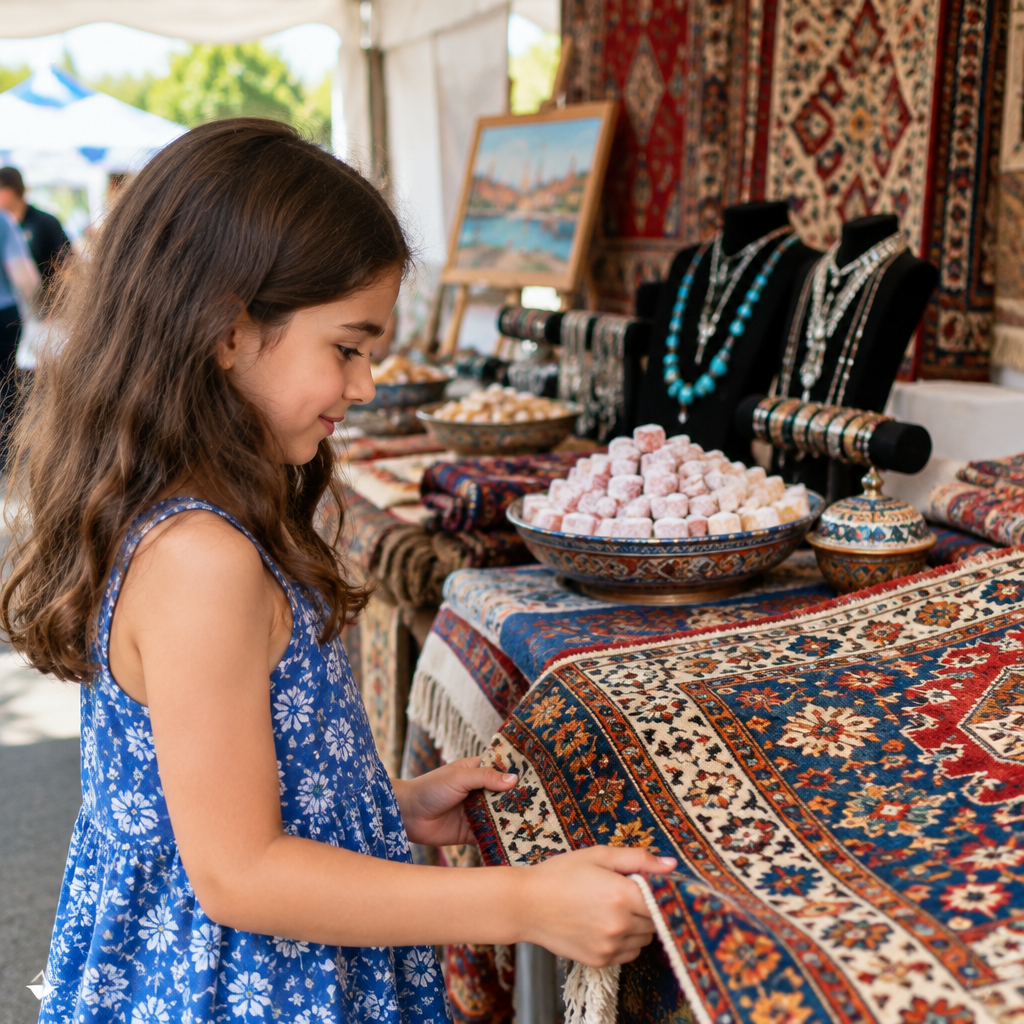
The marketplace is advertised as offering Turkish carpets, jewelry and Turkish delight, while the cultural program includes art and textile exhibitions, documentaries and workshops. Those categories give the festival a visual and educational dimension alongside its stage and food offerings. The announcement does not identify every seller, filmmaker, artist or workshop leader, so it cannot support a detailed inventory of what visitors will find. Even at that level of description, however, the range is meaningful: the planned program includes objects to browse, displays to examine and activities that may invite closer engagement. It offers alternatives for people who do not want to spend their entire visit watching performances.
Youth activities are advertised in the Turkfest Kids Corner, making younger visitors an explicit part of the city’s invitation. The primary notice does not provide a complete children’s timetable or establish supervision arrangements, age limits or whether individual activities carry charges. Families should therefore treat the Kids Corner as an announced program area, not as confirmed drop-off childcare. A visit combining a stage appearance, something to eat and time in the children’s area would fit the festival’s stated range, but the exact balance remains a family choice. The important distinction is between an event that includes youth programming and a promise about services that the announcement does not make.
For the October 10–11 edition, the central story remains the return of a free public celebration with several ways to take part. The city’s notice establishes the venue, anniversary, theme and breadth of attractions; the organizer’s materials sharpen the hours, daily stage program and food-vendor information. Neither set of advance materials establishes attendance, sales, audience response or which scheduled activities ultimately occurred. The festival should consequently be described through its announced program, not through imagined scenes from the Armory. On that basis, Turkfest’s 26th year offers a clearly documented invitation to experience Turkish music, food and cultural presentation together at Seattle Center.
Original source: Read the original article.
Source credit: This news brief is based on reporting from Seattle Center — Center Spotlight.
Original headline: Turkfest | Oct 10-11
Original author: Seattle Center
Original publication date: 2026-10-06
Additional sources and references:
- Turkfest Returns for a 26th Year of Turkish Culture at Seattle Center — Seattle Center
- Festival Schedule — TurkFest
- TurkFest – Turkish Cultural Festival of Seattle — TurkFest
Featured image credit: Image created for ATIIC.


