
The Turkish American Cultural Association of Michigan is accepting applications for two $1,000 Hulya Erol-Garvett Student Scholarships, expanding the program as it reaches its tenth consecutive year. The application deadline is October 26, 2026. TACAM announced the awards on October 4 and credited Erol-Garvett’s continued support for the expansion. The opportunity comes from a community organization whose educational work extends beyond student funding: TACAM also sponsors cultural programs, workshops and activities intended to preserve Turkish traditions and connect Turkish Americans across Michigan. The association describes education and community welfare as central parts of its mission.
The previous year’s announcement provides a useful comparison. On October 2, 2025, TACAM advertised one $1,000 scholarship for an eligible Turkish student attending a Michigan university and described that cycle as the program’s ninth consecutive year. That announcement also identified Erol-Garvett as the contributor supporting the student fund. The documented change in 2026 is therefore an additional award, rather than a larger payment to a single recipient. The older notice remains available on TACAM’s website, but it describes a completed application cycle. Students preparing an application this fall should use the current announcement and its application route, not the form or deadline associated with the previous year.
Eligibility and application preparation
The 2026 opportunity is open to Turkish undergraduate and graduate students studying at a Michigan college or university. TACAM says selection will consider financial need, academic achievement, and involvement in and support for the association. Its announcement directs applicants to a Google Forms application. Those published criteria should be distinguished from the broader advice universities offer about applying for private scholarships. The University of Michigan’s scholarship guide emphasizes that qualifications and required materials differ from one program to another. Applicants should consequently follow the actual TACAM form rather than assume that an essay, recommendation, transcript or other document commonly requested elsewhere is automatically required for this award.

For preparation, the University of Michigan recommends compiling accomplishments before beginning scholarship applications, including employment, leadership, clubs, community activities and family responsibilities. Its guide encourages applicants to organize opportunities by deadline, record the materials each requires, use specific examples in written responses and proofread before submitting. Applied to this opportunity, that approach means preparing an accurate account of academic work and community participation, then using only the information the TACAM application requests. A list of accomplishments is a working resource, not an additional submission requirement. The university also advises applicants to verify that requested documents are included and to keep a record of their submissions. These are general preparation practices, not a description of TACAM’s scoring process.
Questions that remain after reviewing the application should go to the organizer. TACAM’s official contact page provides telephone and email channels and identifies its cultural center at 28847 Beck Road in Wixom. The listed telephone number is 248-438-8580. Students seeking clarification can explain the specific uncertainty, such as whether their enrollment circumstances qualify or how to complete a requested field, instead of relying on an interpretation passed along through an unofficial message. The contact page says the cultural center hosts most association events; it should not be treated as an application drop-off location without confirmation. Likewise, an inquiry to TACAM should not be assumed to replace submission through the announced application process.

A scholarship within TACAM’s educational mission
TACAM was founded in 1972 and identifies itself as a nonprofit public charity. Its stated purposes include improving the educational, social and humanitarian welfare of the Turkish community in Michigan and elsewhere. The association’s description of its work includes educational projects, seminars, cultural gatherings and publications, alongside programs presenting Turkish music, folklore and art. That background places student assistance within a longstanding educational mission rather than an organization devoted exclusively to awarding scholarships. It also explains the cultural dimension of the program: TACAM’s public-facing work is intended both to maintain community connections and to introduce Turkish history and traditions to a wider Michigan audience through organized activities.
The association’s published bylaws provide a more specific account of its relationship with higher education. Approved on May 1, 2021, the document sets out educational, scientific and charitable purposes, including collaboration with Michigan academic institutions and interaction with Turkish student associations at colleges and universities. It also describes involving Turkish American professors in educational activities and organizing charitable fundraising to assist people pursuing educational and scientific goals. These provisions establish an institutional framework for student support, although they do not themselves determine scholarship eligibility or selection. The same document calls for lectures, exhibits, workshops and other cultural programming, connecting assistance for students with the association’s broader work in public education and community collaboration.
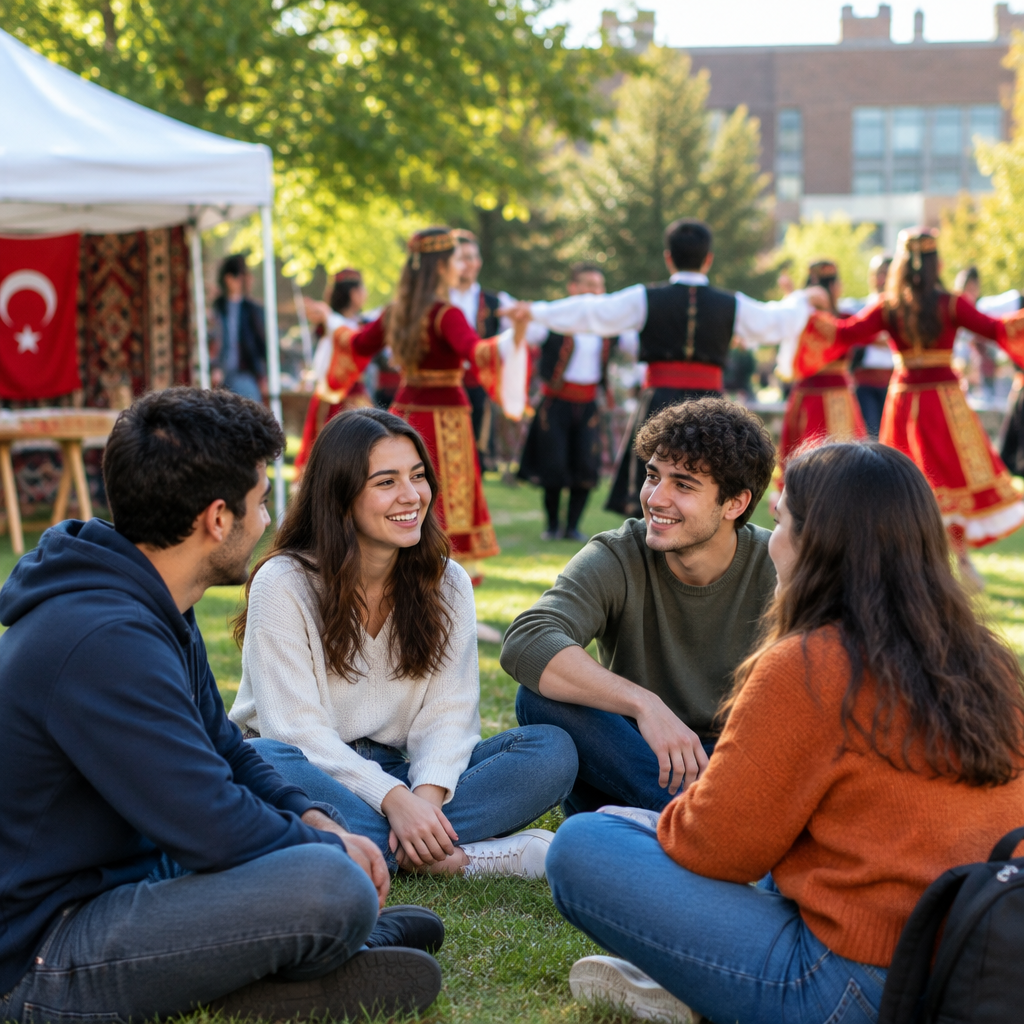
Scholarship recipients are expected to attend at least three TACAM activities and help raise awareness of Turkish culture in Michigan. That expectation has continuity with the earlier program: the 2025 notice also required participation in association activities and support for cultural awareness. The connection is therefore not simply between a donor and an individual student, but between student assistance and participation in the community organization administering it. Applicants should distinguish that continuing relationship from the act of submitting a form. The association’s published outreach goals emphasize service, community connections and cultural exchange, offering additional context for why participation accompanies its educational assistance.
Community activities and the November celebration
TACAM plans to announce the two recipients by the end of October and invite them to its November 7, 2026, Turkish Republic celebration. The association’s event calendar lists the Republic Day Grand Ball at Laurel Manor Banquet and Conference Center, 39000 Schoolcraft Road in Livonia, beginning at 6:30 p.m. Its event description identifies the occasion as a celebration of the Republic of Türkiye’s 103rd anniversary. That wording distinguishes the republic’s anniversary from the age of TACAM itself, which was established decades later. The scholarship announcement places the invitation after the selection timetable; applicants should not confuse the November gathering with the October application deadline or assume that attending the event constitutes an application.
The association’s fall programming illustrates the range of activities surrounding its student-support work. Its calendar lists an October 10 presentation by Dr. Tayfun Bilgin on the written languages of Anatolia, scheduled from 1 to 3 p.m. at the Wixom cultural center. TACAM’s homepage also advertises a new term of Turkish classes for children beginning October 18, with registration announced in advance. These programs show how the organization pursues language education and cultural learning alongside its larger gatherings. They are examples of TACAM’s activities, not a designated scholarship service schedule. Students considering participation should confirm with the association which activities fulfill any recipient expectations and what arrangements apply to attendance or helping with programs.

How an outside award fits into financial aid
An award from a community organization should be considered alongside the recipient’s existing college financial-aid arrangements. The University of Michigan explains that demonstrated financial need is calculated using the cost of attendance, the Student Aid Index and other financial resources. It also says that grants or scholarships may be adjusted when total funding exceeds the cost of attendance and includes university funding. Those policies do not establish that every outside scholarship produces the same change, or that receiving the TACAM award would necessarily reduce a particular student’s assistance. They do establish why recipients should ask their own financial-aid office how an outside award is handled rather than assume it sits entirely apart from the rest of their funding.
Reporting and payment procedures are separate questions from selection. The University of Michigan’s current instructions explain that private scholarship checks may be sent to the institution or directly to a student. A check payable only to the student must still be reported as a financial resource, while checks payable to the university, or jointly to the student and university, require different handling. When an institution receives a check, the sponsor’s instructions can also affect how the award is allocated between terms. These are University of Michigan procedures, not rules governing every Michigan campus or a statement about how TACAM will distribute its awards. A selected student should confirm the payment arrangement with TACAM and the reporting requirements with the institution responsible for the student account.

International-student funding and application safety
For international students, university funding guidance supplies useful context without resolving TACAM-specific eligibility questions. Michigan State University’s Office for International Students and Scholars says some outside organizations provide scholarships to international students and scholars. It also notes that graduate students may find funding through their academic departments. MSU describes its own international-student grants, scholarships and loans as limited, with some programs intended for short-term needs or degree completion rather than an entire course of study. That makes it important to assess each source of assistance on its own terms. An applicant should not treat a community scholarship as a substitute for reviewing departmental funding, existing university support or the financial plan needed to continue a degree.
Students should also keep the legitimate application separate from unsolicited offers of help. The Federal Trade Commission warns that scholarship scams can begin through email, social media or mailed messages and may promise a guaranteed award, demand an upfront processing payment or request bank or credit-card information to hold a scholarship. Its guidance advises students not to pay to apply for a scholarship and to consult school financial-aid staff about available assistance. For this application, the prudent approach is to start with TACAM’s official announcement and use the application it identifies. Any unexpected message claiming special access, guaranteed selection or a payment requirement should be checked independently with the association through its published contact channels before the student provides money or sensitive financial information.
Original source: Read the original article.
Source credit: This news brief is based on reporting from Turkish American Cultural Association of Michigan (TACAM).
Original headline: TACAM Hulya Erol-Garvett Student Scholarship 2026 – Two $1,000 Scholarships
Original author: Merve Sahin
Original publication date: 2026-10-04
Featured image credit: Image created for ATIIC.


