
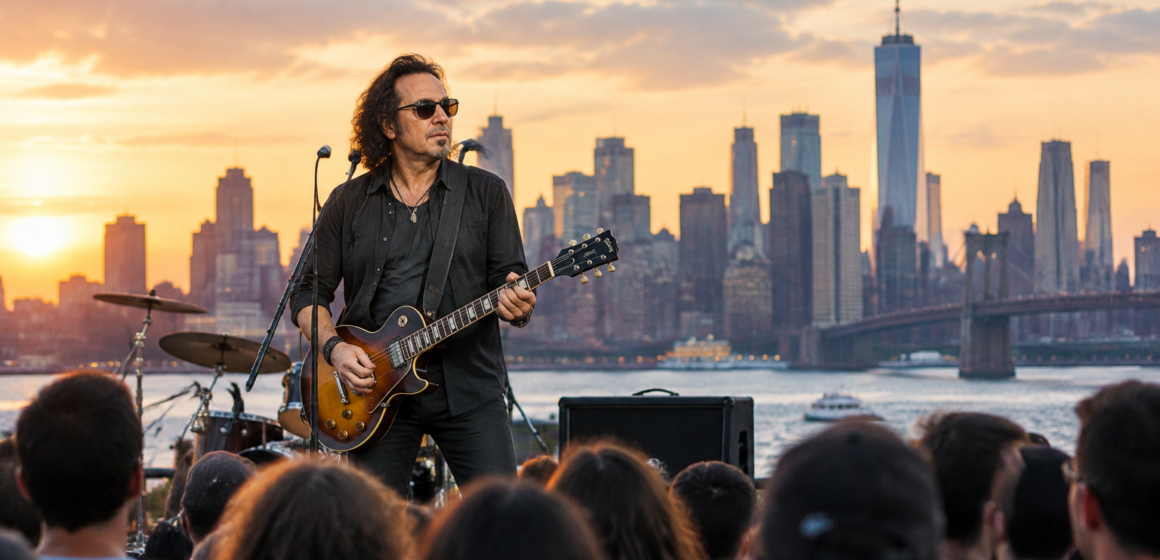
Ogün Sanlısoy to Open North American Tour at New York’s DROM on October 16
Turkish rock singer Ogün Sanlısoy is scheduled to launch a North American tour at New York’s DROM on Friday, October 16, 2026. Hasan Çelik’s October 1 report for Türk USA News describes eight stops across the United States and Canada, with New York opening the journey and Chicago closing it. DROM independently confirms the New York engagement. Together, the announcement and venue listing offer two complementary perspectives: the newspaper establishes the wider tour, while the venue supplies information for attending its opening concert. For readers considering tickets, that distinction matters more than treating every detail of the announcement as a finalized concert guide.
The immediate attraction is straightforward: an opportunity to hear Sanlısoy in person and to make an evening of music with friends. Longtime listeners may approach the concert with favorite recordings already in mind; newcomers can approach it without needing a detailed knowledge of his catalog. Neither group needs to turn preparation into homework. A useful introduction might be exchanging a few songs beforehand, discussing what draws each listener to them, and leaving room for the performance to offer something unexpected. The most sensible expectations are musical rather than predictive: enjoy the announced artist, but avoid assuming a particular running order, guest appearance, or audience response.
A Late-Night Opening Concert in Manhattan
The concert address is 85 Avenue A in Manhattan. For timing, attendees should follow DROM’s dedicated event page, which distinguishes 10:30 p.m. doors from an 11 p.m. show. Türk USA News gives an undifferentiated 10 p.m. time. The venue’s more specific schedule is the better planning reference because it separates admission from performance. Readers should therefore organize their evening around the published doors and show times rather than the earlier report’s single time. That is especially useful when coordinating a group: agreeing on when to meet is a different decision from identifying when the artist is scheduled to begin.
A practical plan would settle the meeting point before anyone sets out. Friends arriving separately can choose whether to gather before entry or meet inside, while remembering that a shared ticket purchase and a shared arrival plan are not necessarily the same thing. Anyone organizing the outing should circulate the official event information rather than rely on a shortened message that drops the distinction between doors and showtime. It is also worth deciding who will retain the purchase confirmation and how the group will communicate if someone is delayed. These are modest preparations, but they can keep the evening focused on the concert instead of last-minute coordination.
The reported route also includes Washington, D.C., Baltimore, Minnesota, Toronto, Montreal, and Edmonton. Those destinations establish the breadth of the announcement without supplying a complete travel-planning package for every stop. Readers considering another engagement should look for its own attendee-facing listing before making arrangements. A destination name alone should not become the basis for choosing a hotel, buying transportation, or assuming a venue. New York listeners, by contrast, can work from a dedicated concert page. Keeping those levels of detail separate allows the wider tour story to remain intact while avoiding an impression that every engagement has been documented equally precisely.

Acoustic Arrangements and a Career-Spanning Preview
Türk USA News reports an acoustic-focused repertoire drawing on different periods of Sanlısoy’s career. DROM’s preview connects him with Pentagram and his solo work, and mentions “Saydım” and “Pencere.” These references are useful introductions, not a guaranteed set list. The distinction is important for anyone buying a ticket mainly to hear one favorite song. A promotional description can suggest the musical territory of an evening without functioning as a performance contract. Listeners can use the named recordings to familiarize themselves with the singer, while leaving the eventual selection and arrangements open rather than constructing an imagined show in advance.
An acoustic emphasis invites a particular kind of listening, but it should not be mistaken for a promise about instrumentation that has not been specified. Fans can pay attention to how familiar material is presented without expecting it to reproduce a recording exactly. One useful approach is to choose a favorite song beforehand and consider which element matters most: the lyric, the vocal delivery, the melody, or the emotional association. That creates a personal point of entry without requiring a prediction about what will be performed. It also gives friends something more interesting to discuss afterward than whether the evening matched an unofficial playlist.

For a group with different levels of familiarity, preparation can remain inclusive. A longtime listener might explain why a recording became meaningful, while a newcomer might simply describe what stands out on first hearing. Neither response needs to be treated as the correct way to enjoy the music. Avoiding assumptions about language ability or prior knowledge can make that exchange more welcoming. The concert can be approached as a shared listening experience rather than a test of recognition. Anyone introducing Sanlısoy to a friend should also distinguish personal favorites from announced material, so enthusiasm does not accidentally become a claim about what the performance will contain.
Tickets, Tables, and Access
DROM lists advance admission at $60 and door admission at $70, restricts this event to ages 21 and older, and specifies a $20 table minimum per person. Before purchasing, readers should decide whether they are planning only for admission or also hoping to sit at a table. Those are separate considerations, and a group budget should reflect that distinction. Someone inviting friends can help by sharing the published terms before collecting money, rather than revealing the seating minimum later. It is also sensible to confirm that everyone in the proposed group meets the attendance requirement before treating the outing as settled.
The venue’s FAQ says tables are generally first come, first served unless otherwise specified. It also directs ticket holders to bring their confirmation email for will-call entry. A group hoping to sit together should ask DROM about the arrangements instead of assuming that buying admission reserves a particular table. Questions are best framed concretely: how many people are coming, whether they hope to sit together, and whether any member has an access requirement. Keeping the confirmation available is another simple precaution. The aim is not elaborate preparation, but resolving the few issues that could otherwise become difficult to address at the door.

For access, DROM reports an elevator at the main entrance and two steps leading to the elevated VIP area. Its FAQ also says ordinary ticket sales are final, while describing refund or credit provisions for canceled events. Anyone who needs step-free access should discuss the intended seating location directly with the venue before purchasing. Asking about the actual route to a proposed seat is more useful than relying on a general accessibility label. Likewise, readers should review purchase conditions before committing, particularly when coordinating several people. A careful inquiry can address the individual circumstances that a short concert announcement cannot reasonably anticipate.
A New York Venue With a Turkish Connection
The setting adds a relevant connection to the story. DROM’s institutional history identifies Turkish entrepreneur Serdar Ilhan as its founder in 2007 and describes cultural exchange as central to its programming. Its mission includes bringing local and international communities together through the performing arts. That background helps explain why the venue is a meaningful setting for this engagement without determining who will attend. The connection is between a visiting Turkish performer and the history of the stage hosting him. It should not be stretched into claims about a guaranteed audience demographic, a particular community turnout, or the reception the concert will receive.

For Turkish American readers, one way to approach the evening is as an opportunity to share a musical interest rather than only revisit familiar material. Bringing a friend who has not heard Sanlısoy can prompt conversations about favorite songs and personal associations without requiring that friend to share the same background. At the same time, nobody needs to represent an entire community simply by attending. A concert can be meaningful at the scale of an individual listener or a small group. That perspective keeps the invitation open and avoids turning a music outing into an expectation about identity, belonging, or how an audience ought to respond.
Before leaving for the concert, attendees should revisit the official event page and compare it with their purchase confirmation. Any unresolved question about seating, access, or entry should be directed to DROM rather than answered by inference from the broader tour announcement. The same discipline applies to musical expectations: distinguish what has been advertised from what a fan hopes to hear. With those practical matters settled, there is little reason to overcomplicate the evening. The opening engagement offers a clear occasion to hear Sanlısoy live, spend time with fellow listeners, and let the actual performance—not assumptions made beforehand—define the experience.
Original source: Read the original article.
Source credit: This news brief is based on reporting from Türk USA News.
Original headline: “SANATÇI OGÜN SANLISOY AMERİKA’YA ÇIKARMA YAPIYOR”
Original author: Hasan Çelik
Original publication date: 2026-10-01
Additional sources and references:
- Ogun Sanlisoy — DROM
- FAQ — DROM
- About — DROM
Featured image credit: Image created for ATIIC.